
This is based on my last Umrah from 2 April to 14 April.
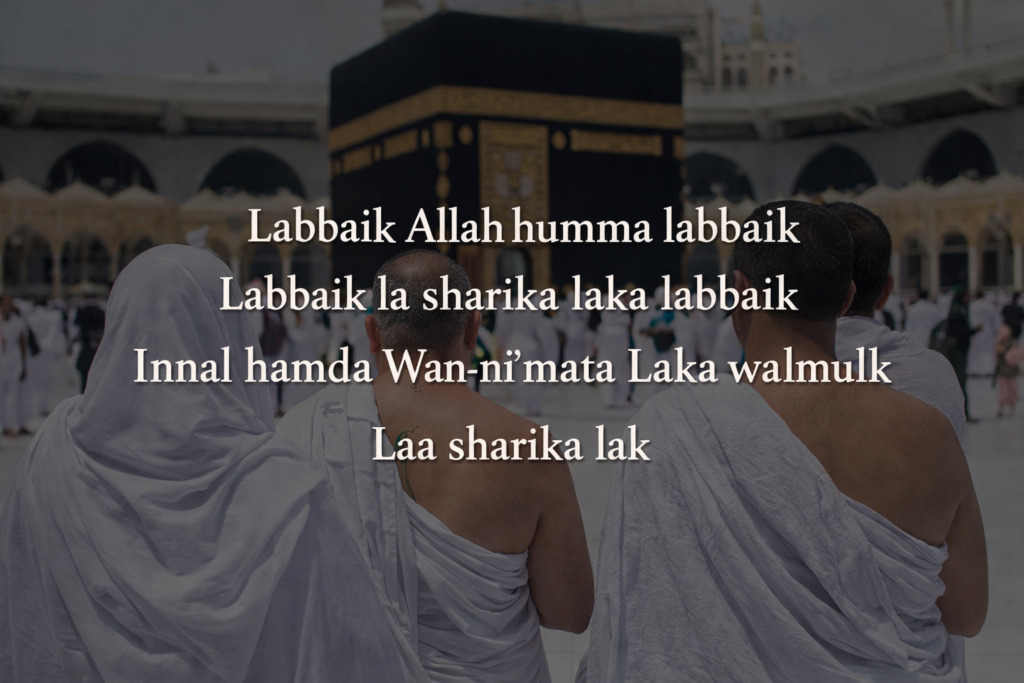
Meaning:
O my Lord, here I am at Your service. Here I am. You have no partner. Truly all praise, blessings, and sovereignty belong to You.
(Recite this as much as possible throughout your journey.)
By the Grace and Mercy of Allah SWT, Umrah for South Africans has become easier and very doable without the services of a travel agent. Whilst there are travel agents that offer excellent package deals, in our experience we managed perfectly well without one and enjoyed the privacy of making our Umrah our very own personal event.
The first thing you will need to apply for is your visa. The Saudi e-visa system is online and, in most cases, offers a one-year multiple-entry visa. So if you are fortunate enough to perform Umrah twice or even three times in a year, you won’t need to apply again.
Next comes your flights.
In 2025, Ethiopian Airlines offered very good deals, and they fly directly to Madinah from Addis Ababa, which is a huge advantage if you are visiting Madinah before proceeding to Umrah in Makkah. Based on our trip, we chose Ethiopian Airlines, which includes a layover in Addis Ababa depending on your booking times.
On our first leg from Johannesburg to Addis, we had almost no layover, which was great. We arrived in Addis at 9pm (one hour ahead of South Africa). By the time we disembarked, we had enough time to refresh, pray missed salah in the small musallah near the bathrooms, and grab a cup of coffee. The three hours went by quickly, and we headed to the boarding gate for Jeddah around midnight. The flight to Jeddah is approximately 2.5 hours, and you are there.
Ethiopian Airlines arrives at the North Terminal in Jeddah. I found this information useful, as it will help me make a more informed decision for our next Umrah, In shaa Allah.
The North Terminal is quite far from the Haramain Train Station. Although it is within the airport vicinity, Jeddah Airport is massive, so you will need a taxi to reach the train station. This can take about 30 to 40 minutes depending on traffic.
If you choose Emirates, Qatar, Turkish, or Saudi Airlines, you will arrive at Terminal 1, which is within walking distance of the Haramain Train.
The Haramain Train makes travel between Jeddah, Madinah, and Makkah very convenient. The bullet train significantly reduces travel time, allowing better planning and time management. This is a huge advantage if you are coming for Umrah, as you will have more time to check into your hotel, refresh, and then proceed to the Al Haram.
That said, if you wish to go with taxis – they are everywhere — airports, train stations, hotels and you can negotiate good rates. The vehicles are generally comfortable as well.
On our trip from Makkah to Jeddah Airport (about 40+ minutes), we took a taxi. The driver was very pleasant and even gave us a little history lesson. He pointed out the burial site of Maymuna bint al-Harith (RA), one of the wives of our beloved Nabi Muhammad (SAW). She is buried in Sarif, about 20 kilometres north of Makkah, near the place where she married the Prophet (SAW) which at the time was a Tree. If it is not pointed out to you, you would never notice it, so we truly appreciated that unexpected lesson ❤️
The Nusuk app is necessary; however, I found that not all authorities check it thoroughly, which allows some flexibility with your booked times for Umrah or Rawdah in Madinah.
For example, my Rawdah appointment was at 1:40am and Omar’s was at 2:40am. Since we were both excited for our Rawdah meeting, we stayed awake the entire day and night. Close to midnight, we walked to the ladies’ Rawdah entrance and found it open with women entering. Omar suggested I ask the guard if I could go in early, and to my surprise, she said, “You’re welcome,” without checking my Nusuk app. However, when Omar went to the men’s section, he had to wait until his scheduled time of 2:40am.
In the ladies’ section of the Rawdah, you are meant to receive about 20 to 25 minutes, but after roughly 10 minutes the guards begin ushering people out by closing off sections. To maximise your time, don’t rush out immediately. Keep moving back gradually so you may find yourself among the last to exit that mubarak area. The guards have their duty, and you can gently manage your time wisely.
It is a deeply emotional experience. Sometimes you are so overwhelmed that you forget the duas you planned to make — don’t stress. Allah Subhanahu wa Ta’ala knows your heartfelt duas. Spend your time greeting our beloved Prophet (SAW) and his companions. Start reading salawat before you enter, and you will feel your heart pounding and tears flowing as you approach the Rawdah. You truly cannot control the emotions.
Ladies do not see the actual Qabr area, but know that it is right there. The area accessible to women is called Riyad al-Jannah, known as a piece of Paradise. It lies between the Mimbar and the house of our Beloved Prophet (SAW). The Sacred Chamber (al-Hujra al-Sharifa), located beneath the Green Dome, contains the graves of Prophet Muhammad (PBUH), Abu Bakr (RA), and Umar (RA). Historically, the enclosed chamber measures approximately 16 metres on the north and south sides and 15 metres on the east and west sides.
The original house of the Prophet (PBUH), where he was buried in the room of Aisha (RA), was a simple mud-brick structure approximately 5m by 4m.
As Salaatu Was Salaamu Ya Nabi Allah,
As Salaatu Was Salaamu Ya Habib Allah,
As Salaatu Was Salaamu Ya Muhammad Rasulullah.
Always be mindful never to raise your hands when facing the Qabr. Instinctively you may want to, but keep your hands resting on your chest or stomach. We raise our hands only to Allah. Duas are made to Allah SWT; greetings are sent to our beloved Nabi Mustafa (SAW) and his companions.
If you feel you did not get enough time inside the Rawdah, you can stand outside near the Green Dome and continue sending salutations and making dua. You won’t be rushed there, and you can spend as much time as you wish reflecting.
Visiting the Rawdah truly culminates your Madinah trip. It brings everything together and gives it purpose.
UMRAH
Niyah for Haj / Umrah after doning your Ihram
Allahumma laka ahramu nafsi wa sha’ri wa bashari wa lahmi wa dami. Oh Allah I consecrate my soul, my hair, my skin, my flesh and my blood to You. Allahumma inni nawaytu-l-Hajja fa-a’inni ‘alayh, wa taqabbalhu minni. Oh Allah, I have made my intention for Hajj / Umrah, so help me with it and accept it from me.
Traveling by Airplane:
Pilgrims traveling by airplane often wear Ihram at the airport before boarding to avoid delays at the Miqat. So you can wear your ihram from Jeddah , Madinah , even your gateway airlines like Ethiopian , Turkish , Emirates , Qatar – wherever you are and you know you will be entering Makkah for Umrah.
As for Umrah itself, the guards generally do not check the Nusuk app. Their main concern is that men are in ihram. Ladies, who generally wear abayas daily in Makkah, are allowed to enter through Bab Al Salam (Gate 63), known as the Umrah Gate, which leads directly to the Holy Kaaba.
When you enter this gate for the first time, keep your gaze lowered for as long as you can. When you finally lift your eyes and they fall upon the Kaaba, don’t be surprised if your emotions overwhelm you. It is one of the most beautiful and powerful experiences of a lifetime. That first glance is also the perfect moment to make your heartfelt dua ❤️
Before I go into the actual rituals of the Umrah please allow me to give you some good advice – if you are travelling with minors or the elderly, make sure they have identification on them at all times. Travel agents usually provide tags with personal details such as names, Saudi contact numbers, hotel names, and room numbers. If you are travelling independently, you can easily create your own tags — either plastic holders worn around the neck or wrist tags. It gives peace of mind, especially in large crowds.
The first ritual of Umrah is Tawaaf. It is simple and beautiful. Tawaaf begins and ends at the green light, which aligns with the Hajr Aswad (the Black Stone). Each time you pass the Black Stone, it is Sunnah to say Takbeer and either raise your right hand towards it or blow a kiss in its direction.
During tawaaf, you may recite short surahs, the second and third kalimah, Ayatul Kursi, or any supplications you know by heart. I personally suggest reciting what you are familiar with so you are not constantly reading from a book and missing the beauty of gazing at the Kaaba. Looking at the Kaaba itself is a form of worship. Keep your gaze upon it and let your heart connect. Remember, you are His guest. You are only there because He has called you 🤲❤️
Takbeer to be recited each time you pass the Green light /hajar aswad .
Allahu Akbar, Allahu Akbar, Allahu Akbar,
La ilaha illallah, Allahu Akbar, Allahu Akbar,
Wa lillahil hamd.
Umrah brings immense blessings: expiation of sins, increased spiritual connection with Allah, humility, gratitude, family bonding, and inner peace.
Tawaaf on the mataf (ground level) is quicker, depending on the crowd. Tawaaf on the upper level can take approximately 40 to 45 minutes longer, also depending on how busy it is.
The quieter months for Umrah are Muharram and Safar, after the Hajj season. During these months, it is more serene, and performing tawaaf on the mataf is very likely. Touching the Kaaba, the Hajr Aswad, and Maqam Ibrahim becomes more possible.
That said, it is all about personal preference. Some people prefer to stay on the outer rings because they feel uncomfortable being too close to the crowds — and that is perfectly fine. If that is you, remain on the outer ring and focus on your connection with Allah.
If you are like myself and yearn to touch the Baitullah, then ask Allah — He will make a path for you. Touching the Kaaba may seem like a physical act, but spiritually it is so much deeper. When your hand rests on the House of Allah, you reflect on its history — from the time of Aadam (AS), to Ibraheem (AS), and to our beloved Muhammad (SAW). You feel the weight of that sacred history and the blessings pouring down upon you. It is also one of the most powerful moments to make your most fervent duas.
After completing seven circuits, your tawaaf is complete. If possible, perform two raka’ah behind Maqam Ibrahim. Thereafter, drink Zam Zam water before proceeding to Sa’ee.
Sa’ee is the walk between Safa and Marwah. It is fully air-conditioned and can be done at your own pace. It also consists of seven laps — beginning at Safa and ending at Mount Marwah. Sa’ee can be performed on two levels, both of which are manageable and enjoyable.
For wheelchair pilgrims, there are wheelchairs and wheelchair attendants available. If you are performing Umrah, the manual wheelchairs provided by the Kingdom are complimentary.
Women walk at a modest pace throughout. The light jogging (Raml) between the green markers is specifically Sunnah for men, commemorating how Lady Hajar (RA) ran between the hills in search of water for her son Ismail (AS).
Once Sa’ee is completed, offer two raka’ah on Mount Marwah if possible. By this stage, you will likely feel physically exhausted but spiritually fulfilled. Drink more Zam Zam water, make abundant dua, and Alhamdulillah — your Umrah is complete.
Men may either shave their heads completely or trim their hair. Women must snip a small portion of their hair. Barbers are readily available for men — they will often approach you and guide you to their shops. Women can trim their hair in their hotel rooms. It is advisable to pack a small pair of scissors in your checked luggage (not in hand luggage).
Please note: when performing Umrah as part of Hajj, men are required to shave their heads completely.
Once this is done, you are officially out of ihram.
Now you can relax. Food outlets in Makkah and Madinah operate 24/7. Shops, barbers, and restaurants rarely close, so you will never go hungry.
This brings me to the food and shopping experience. I will cover Makkah & Madinah here.
In both Makkah and Madinah, I found that many eateries sell similar types of food unless it is a specific brand such as Al Baik or Hardee’s. You will commonly find burgers, shawarmas, rice dishes, and various forms of biryani — though their biryanis differ slightly from South African ones.
Most hotels offer excellent breakfasts that can easily carry you through to lunch. Some serve breakfast until 10 or 11am.
In Madinah, we stayed at The Rove, which is less than a three-minute walk to the ladies’ section of Masjid Nabawi (Gate 338). I absolutely loved that convenience. Their breakfast offered a wide selection — cereals, Mediterranean salads and dips, hot dishes, pastries, and a variety of breads. The only thing Omar and I personally missed was a good bean-to-cup coffee, as the hotel served instant coffee. However, we found a Dunkin’ coffee shop next door in the arcade, which solved that problem.
For dinner, we explored various cuisines — Indonesian, Bangladeshi, and Pakistani restaurants. There is also the lively Quba Square, especially after Esha salah. It is within walking distance of Masjid Nabawi and filled with kiosks offering different foods labelled Italian, Turkish, Afghan, and more. While not always entirely authentic, it is a vibrant and enjoyable atmosphere to experience.
Shopping in Madinah is wonderful for dates, pistachios, almonds, musallahs, and perfumes. In Makkah, abayas, scarves, and thobes are generally more reasonably priced. Always bargain — the traders expect it, and it becomes part of the experience.
However, shopping should never overtake your ibadah. Make specific time for shopping and stick to it. In both Makkah and Madinah, time passes very quickly. If you are not mindful, you may find yourself late for salah.
The two adhaans for prayer are very helpful. The first adhaan allows you time to make your way into the Al Haram and find a good spot. By the iqamah, you should be standing in the safs, ready for prayer.
A very important reminder — especially for the ladies — is to make space for others in the Al Haram. Sometimes people lie down or spread belongings next to them, occupying more space than necessary.
Allah says in Surah Al-Mujadilah (58:11):
“O you who have believed, when you are told, ‘Make space’ in assemblies, then make space; Allah will make space for you…”
It is a simple yet powerful reminder.
Regarding accommodation in Makkah , staying as close as possible to the Al Haram is, in my opinion, a great advantage.
The Advantages include:
Easier access to good spots inside the Al Haram.
Walking distance convenience.
Quick return to your room after salah.
Better accessibility for elderly or wheelchair users.
The only real drawback is the cost. Hotels further than 3km away are much cheaper and may offer shuttle services, but traffic or construction can cause delays. You may then need to walk or take taxis, which adds additional costs over the duration of your stay. Personally, I would rather pay a little extra to stay on the doorstep of the Al Haram and fully enjoy the experience. Another suggestion to bear in mind from a spiritual aspect , most hotels have the musallas that you can pray in however make the effort of going to Al Haram – the rewards for praying just one salah in the Al haram sharieff is equivalent to 100 000 prayers so do the math – it is a massive reward multiplier. Alhamdulillah.
Al Safwa Towers is a decent option, consisting of Towers 1, 2, and 3. The standards are good, and the breakfast was excellent — more like a brunch. Alongside traditional breakfast items, they served dishes such as dhal, rice, lamb curry, chicken curry, hot chapatis, noodles, nuggets, burgers, and wraps. You are also welcome to take fruit or pastries back to your room. Their coffee machines were excellent — we enjoyed a proper cup every morning.
Shopping was conveniently located downstairs at Safwa Market, which sells almost everything. There is even a clinic in the basement level, available to visitors, particularly those with chronic conditions. For minor colds or flu, pharmacies are readily available nearby.
Next door is the Clock Tower shopping centre, with many branded food chains and the Hilton food court offering additional options.
One thing is certain — you will not go hungry in Makkah or Madinah. But more importantly, your soul will not go hungry either.
An Umrah maqbool & mabroor to all embarking or making niyah to visit . These notes are purely my sentiments & I hope it helps in some way or the other to make your trip as significant & momentous as possible.
If you would like a printable guide for Umrah to take with you. Contact me – I will be more than happy to post one to you with my compliments.
Please keep me in your Duas 🤲
quraishaisaacs@gmail.com
South Africa.
Oh yes! My Final Postscript
Many do not know what to say in the funeral prayer:
The first Takbir: Surah Al-Fatiha
The second Takbir: The Ibrahimic prayer
The third Takbir: Supplication for the deceased and for the Muslims